


Clover-X
Loading

Technology Partner

Secure, connected technology for businesses that mean to grow.

One team across security, web apps, software and communication technology, so you have a single partner who understands how all of it fits together.

Services

Four disciplines, one accountable team

Most businesses juggle separate vendors for security, websites, software and phones. We cover all four, and we make sure they work together.

  • Security

    Find the gaps before someone else does, and close them for good.

    • Security assessments and audits
    • Penetration testing
    • Secure architecture and hardening
    • Monitoring and incident response
  • Web Apps

    Web tools your customers and staff actually enjoy using.

    • Custom web applications
    • Portals and dashboards
    • APIs and integrations
    • Websites and e-commerce
  • Software

    Software shaped around how your business really works.

    • Custom software
    • Desktop and mobile apps
    • Automation and internal tools
    • Maintenance and modernization
  • Communication Technology

    Clear calls, reliable networks and teams that stay connected.

    • VoIP and unified communications
    • Messaging and collaboration platforms
    • Network and connectivity design
    • Video conferencing and contact-center setup

Why Clover-X

Principles we work by

  • Security by default

    Every project starts with security in the plan, not bolted on at the end.

  • One team across the stack

    Network, software and web handled by people who talk to each other, so nothing falls between vendors.

  • Built to scale

    We choose tools and designs that grow with you instead of needing a rebuild in two years.

  • Plain-language communication

    Clear updates, honest estimates and no jargon walls. You always know where things stand.

Process

How we work together

  1. Discover

    We learn how your business runs, what is slowing you down and where the risks are.

  2. Design

    We propose a clear plan with scope, timeline and cost before any work begins.

  3. Build

    We deliver in small, visible steps so you can review progress and change course early.

  4. Support

    After launch we monitor, maintain and improve, so your systems stay healthy.

Team

The people behind Clover‑X

Specialists in identity & access management and security operations. Click a card to see that person's portfolio.

Projects

What our team has built

Security tools, automation and platforms designed and built by the Clover‑X team, with the code behind them.

  • SecuritySoftware2026 – present

    AccessPilot: identity governance platform

    A governance layer over Entra ID, Okta and Active Directory that controls who has access to what, for how long, and under whose approval.

    By Aman Varma

    • Python / FastAPI
    • PostgreSQL
    • React / TypeScript
    • Graph API
    • Okta
    • LDAPS
    • SoD
    • Access Reviews
    Read case study: AccessPilot: identity governance platform

    Problem

    Directories like Entra ID, Okta or Active Directory handle authentication, but none provides an end-to-end request, approval, activation, expiry and review lifecycle across several directories.

    Approach

    FastAPI backend with PostgreSQL and a React/TypeScript frontend. One shared connector interface for Entra ID (Graph API), Okta, Active Directory (LDAPS) and CSV/HR feeds, with a joiner-mover-leaver engine, birthright policies, access packages, business roles, multi-stage workflows, separation of duties, access reviews, an entitlement catalog and audit logging on top.

    Result

    A working IGA platform with HR pull sync, multi-directory provisioning, self-healing background workers and break-glass access, documented in a full architecture reference.
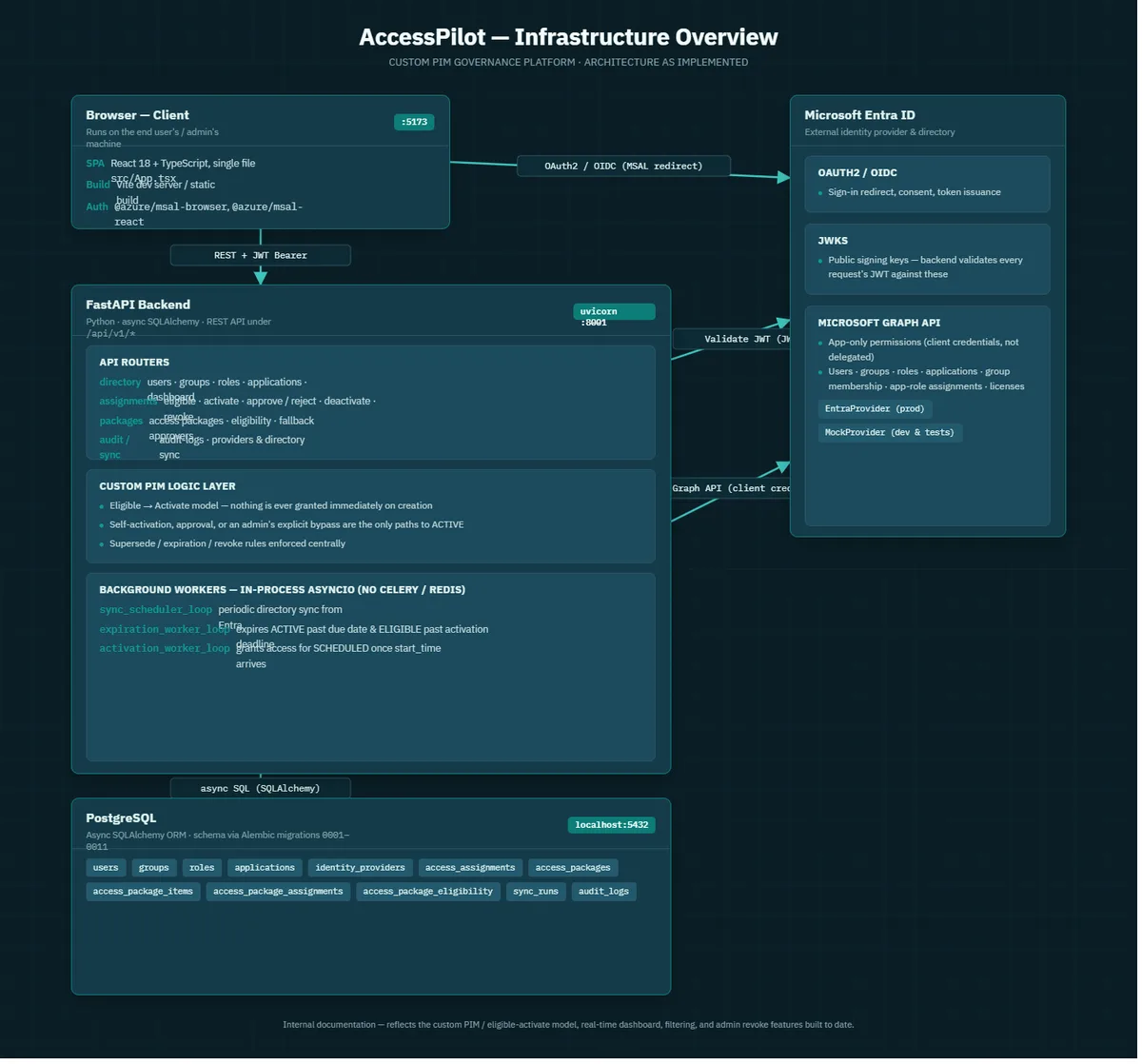
    AccessPilot architecture: React client signs in through Entra ID, calls a FastAPI backend with a custom privileged-access logic layer and background workers, backed by PostgreSQL.
    Infrastructure overview
  • SecurityWeb Apps2026

    SafeLine WAF on a bare-metal hypervisor

    A web application firewall running as its own security VM on a KVM/QEMU hypervisor, inspecting every request before it reaches the web application.

    By Nihar Mehta

    • KVM / QEMU
    • NGINX
    • ModSecurity v3
    • OWASP CRS
    • iptables
    • Ubuntu
    Read case study: SafeLine WAF on a bare-metal hypervisor

    Problem

    Web applications face SQL injection, XSS, command injection, path traversal and flood attacks, and need protection that sits in front of the app rather than inside it.

    Approach

    A dedicated WAF virtual machine on a Type-1 hypervisor with three protection layers: iptables and kernel hardening at the network layer, NGINX rate limiting at the application layer, and ModSecurity with the OWASP Core Rule Set inspecting payloads.

    Result

    Blocks SQL injection, XSS, remote code execution, local file inclusion, path traversal and DoS/DDoS traffic before it reaches the backend, with scripts for setup, testing and monitoring.

  • Security2026

    NetSentinel: IDS/IPS with machine learning

    A lightweight network intrusion detection and prevention system that combines signature rules with machine-learning anomaly detection.

    By Nihar Mehta

    • Python
    • Scapy
    • scikit-learn
    • Isolation Forest
    • pandas
    • Matplotlib
    Read case study: NetSentinel: IDS/IPS with machine learning

    Problem

    Signature rules catch known attacks but miss new ones, while small teams still need real-time visibility into their network traffic.

    Approach

    Real-time packet capture with Scapy, a rule engine for port scans, SYN and ICMP floods, suspicious ports and DNS amplification, plus Isolation Forest anomaly detection that learns normal traffic. Runs in detection (IDS) or prevention (IPS) mode.

    Result

    Real-time alerts with severity levels and a dashboard showing alert timelines, traffic heatmaps and top attacker IPs.

  • SecurityWeb Apps2025

    PhishIntel Analyzer

    A web app that analyses phishing .eml files using an NLP model, heuristics and threat-intelligence lookups.

    By Aman Varma

    • Python
    • Flask
    • NLP
    • Threat Intelligence
    Read case study: PhishIntel Analyzer

    Problem

    Assessing suspicious emails quickly and explainably needs more than a single detection method.

    Approach

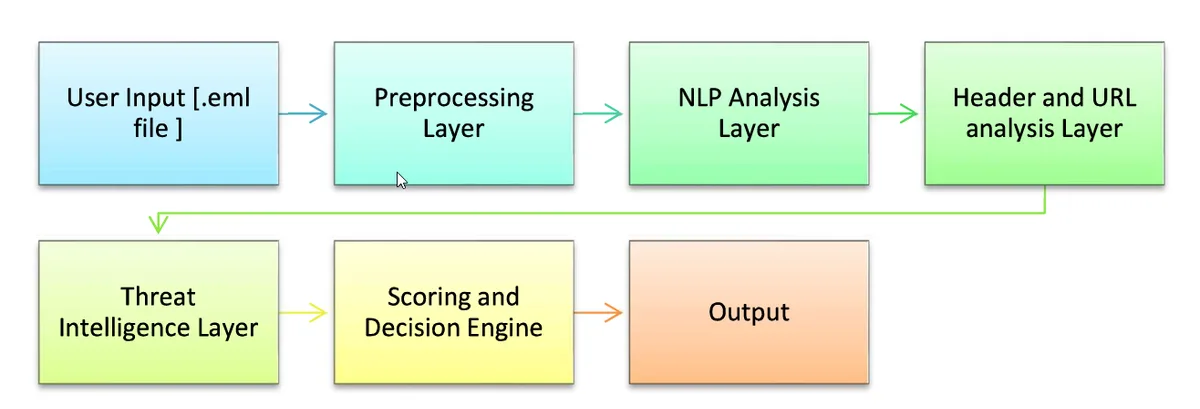
    A Flask app that parses .eml files and combines three methods: a pre-trained NLP model, rule-based heuristics and threat-intelligence integration.

    Result

    Each email is scored using all three methods, documented in an article and a project report.

    PhishIntel pipeline: email input, preprocessing, NLP analysis, header and URL analysis, threat intelligence, scoring and decision engine, output.
    Analysis pipeline
  • SecuritySoftware2026

    Mini SOAR platform with n8n

    Automated threat detection and response: a security alert is enriched with threat intelligence, scored and, if dangerous, blocked automatically.

    By Nihar Mehta

    • n8n
    • Docker
    • VirusTotal API
    • AbuseIPDB API
    • JavaScript
    • Webhooks
    Read case study: Mini SOAR platform with n8n

    Problem

    Investigating each security alert by hand takes 10–15 minutes, which does not scale when alerts arrive by the hundred.

    Approach

    An n8n workflow receives alerts by webhook, queries VirusTotal and AbuseIPDB in parallel, merges the results, calculates a risk score and routes high-risk IPs to the firewall for blocking while logging the rest.

    Result

    Alerts are triaged and high-risk IPs blocked automatically in about four seconds per alert, with every step logged.

  • Communication TechnologySecurity2025

    IoT traffic analysis: MQTT with Wireshark

    A case study capturing and analysing MQTT traffic between simulated IoT devices and a broker to expose unencrypted communication.

    By Nihar Mehta

    • Wireshark
    • MQTT
    • IoT
    • TLS
    Read case study: IoT traffic analysis: MQTT with Wireshark

    Problem

    Many IoT devices talk over unencrypted MQTT, exposing credentials and sensor data to interception, spoofing and replay attacks.

    Approach

    Set up an MQTT broker and simulated sensor, captured the publish/subscribe traffic in Wireshark and analysed payloads, headers and topics.

    Result

    Demonstrated plain-text message exposure and documented defences: MQTT over TLS, broker authentication, topic permission audits and traffic monitoring.

Contact

Tell us what you are working on

Share a few details and we will reply within two business days with next steps. No obligation, no sales pitch.

What are you trying to achieve, and is there a timeline?